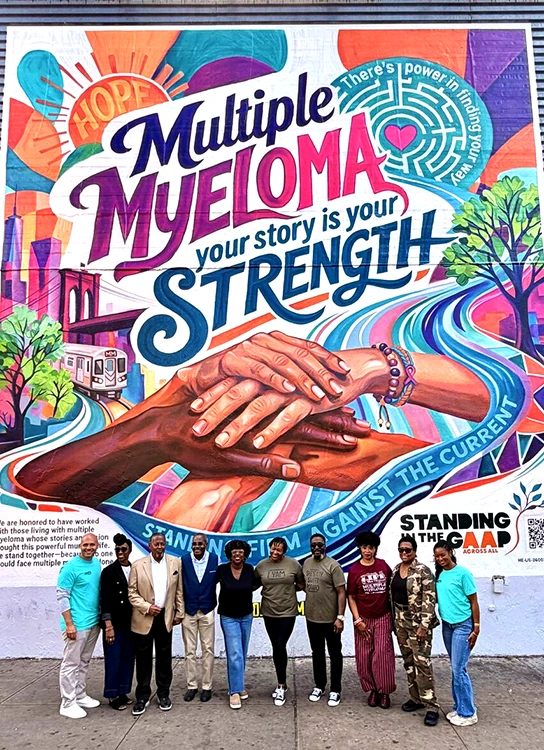
For the 13-year multiple myeloma survivor, the artwork is more than paint on a wall. Woven into its design is imagery that represents the faith she leaned on through some of the most difficult moments of her cancer journe
Her story is one of several reflected in the Standing in the Gaap mural, a new public artwork inspired by the experiences of myeloma survivors and caregivers.
Stories written into the wall
The mural was shaped through a co-creation session with Malone and five other myeloma survivors, plus two caregivers. Together, they shared stories about who and what helped them keep going, from family and friends to faith and care teams. Those experiences shaped the mural's design, turning many personal journeys into a single, shared expression.
One of the mural's most striking elements was inspired by Richard Armstrong, a five-year myeloma survivor who helped shape its central image of hands coming together. For Armstrong, the visual represents the support and community that helped him navigate the challenges of diagnosis and treatment.
By inviting survivors and caregivers into the creative process, the mural does more than depict their stories. It carries their voices into a public space where others can see themselves, learn and connect.
More than a mural
Located at Jefferson Street and Wyckoff Avenue in Brooklyn, the [DIMENSIONS] mural sits within Bushwick, one of New York City's most culturally diverse neighborhoods. The setting reflects the spirit behind Standing in the Gaap and creates an opportunity to bring multiple myeloma awareness directly into the community.
Standing in the Gaap was created to help address disparities in multiple myeloma through community education and culturally relevant resources designed to meet people where they are. The initiative’s distinctive double “A” represents “Across All,” reflecting its focus on reaching people affected by myeloma across communities.
Over the past decade, the program has focused on strengthening and broadening understanding of multiple myeloma care pathways and supporting community engagement. Since its inception, the program has reached more than 5,000 attendees through over 50 educational programs and has built a highly engaged digital community of nearly 60,000 people.
A QR code embedded in the mural connects visitors with Standing in the Gaap information and resources , extending the experience beyond the wall. The mural also serves as a focal point for community engagement, opening the door to conversations about multiple myeloma, the people it affects and the importance of trusted support.
Why multiple myeloma awareness matters
As we continue to deliver scientific innovation for people living with myeloma, including recent advances across our cell therapy and CELMoD programs, we’re also committed to addressing barriers that can affect awareness and access to care. That work remains especially important because multiple myeloma disproportionately affects certain communities.
African Americans are approximately twice as likely to be diagnosed with the disease, with the burden particularly significant among Black men. Hispanic patients are often diagnosed at younger ages, and patients in rural communities often face additional barriers to care that can contribute to poorer outcomes and higher mortality rates – all reinforcing the need for outreach that reflects the experiences of each community.
Armstrong’s experience shows why awareness matters. Before his diagnosis in 2021, he attributed severe back pain to an old injury and shortness of breath to lingering effects of COVID-19. Imaging later revealed lesions on his spine, and further testing confirmed advanced myeloma.
“I knew what multiple myeloma was, but I didn’t know the symptoms,” Armstrong said. “After my diagnosis, I looked them up and was stunned by how closely they matched what I had been experiencing. Looking back, I realized I might have recognized something was wrong months earlier if I had known more about the disease.”
For Malone, expanding awareness is just as important as sharing her own story. She believes access to trusted information can help people better understand multiple myeloma and seek support when they need it most.
A new chapter for Standing in the Gaap
As Standing in the Gaap marks 10 years, the initiative is entering a new chapter with a refreshed website and additional community-based programs designed to reach patients and caregivers where they are. The mural is one piece of that continued evolution, creating a visible symbol of the program while connecting people to education, resources and ongoing community engagement.
Back on the Brooklyn streetscape, the mural brings those goals into view through the experiences of the people who helped create it. More than a work of art, it is a call to learn, connect and help close the gaps that remain for people affected by myeloma. And for Armstrong, it represents the opportunity to turn his own experience into support for someone else.
For more information about Standing in the Gaap and available resources, visit www.StandingInTheGaap.com.
Disclosure: Patients featured in this article are compensated by Bristol Myers Squibb for their participation in Standing in the Gaap-related activities. Their perspectives and experiences are their own.