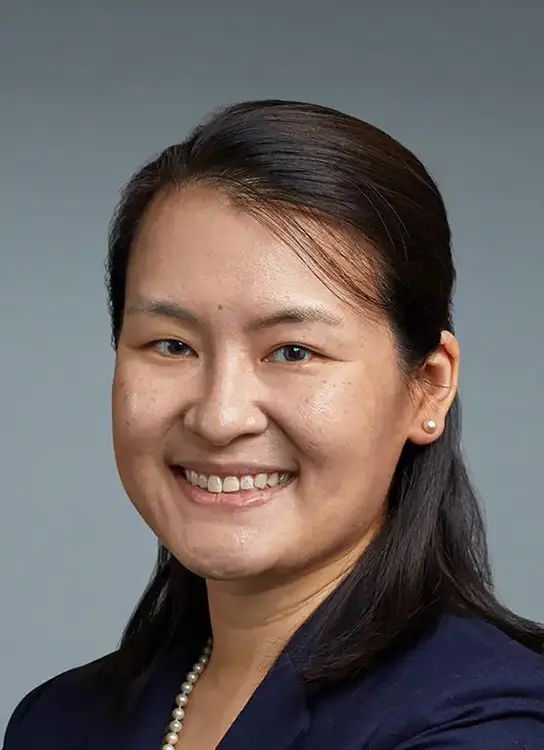
As a thoracic oncologist, Dr. Elaine Shum’s work sits at the intersection of cutting‑edge science, patient advocacy and a commitment to deeply human connection. Every day, she brings together innovation and empathy to ensure patients not only receive the best possible care, but also something just as vital: hope.
Dr. Shum’s path into oncology was shaped early by a love of science and the exposure she gained to the field from her father, who is also an oncologist. During her training, advances in immunotherapy and targeted treatments were rapidly transforming lung cancer care, opening the door to more precise, individualized approaches. These breakthroughs, combined with the guidance of influential mentors, led her to specialize in thoracic oncology, a field that would allow her to expand her scientific curiosity and enable meaningful patient relationships.
A major focus of Dr. Shum’s work is advocating to expand lung cancer screening guidelines. Throughout the course of her work, she has seen many patients that never smoked be diagnosed with lung cancer in more advanced stages of the disease since they did not qualify for routine screening.
Following this realization, Dr. Shum and her colleagues at NYU launched the Female Asian Never‑Smoker Screening Study (FANSS), a pilot program designed to explore lung cancer screening in a high‑risk non‑smoking population. The study offered low‑dose CT scans to Asian women with no smoking history, a group with a higher risk of lung cancer that has been historically excluded from U.S. screening guidelines.
The results were striking. Among 1,000 enrolled participants, early lung cancer was detected in a percentage of the women, who otherwise had no symptoms and no access to standard screening, that was on par with the number of lung cancers detected in populations with a heavy smoking history. For Dr. Shum, the impact was multi-faceted: the study generated evidence that could shape future screening guidelines to reduce disparities in care, while also changing the lives of the patients who were diagnosed early.
She is also passionate about dismantling the long-held misconception that lung cancer is only a smoker’s disease, recognizing the emotional toll of such stigma. Too often, patients feel blamed for their diagnosis, adding an unnecessary burden at an already vulnerable time. Through her work, she aims to shift public perception and reinforce a simple message: lung cancer can affect anyone, and no patient deserves to face judgement as a result.
For Dr. Shum, hope is not an abstract concept, it is central to oncology care. Whether it comes from scientific progress, expanded access or a trusted relationship between patient and provider, hope sustains patients and care teams alike.
As a Champion in Care, Dr. Elaine Shum exemplifies what it means to put patients first, through innovation, advocacy and unwavering compassion. Her work reminds us that advancing medicine is not only about developing new treatments, but also about ensuring every patient is seen, supported and given the opportunity for a better tomorrow.