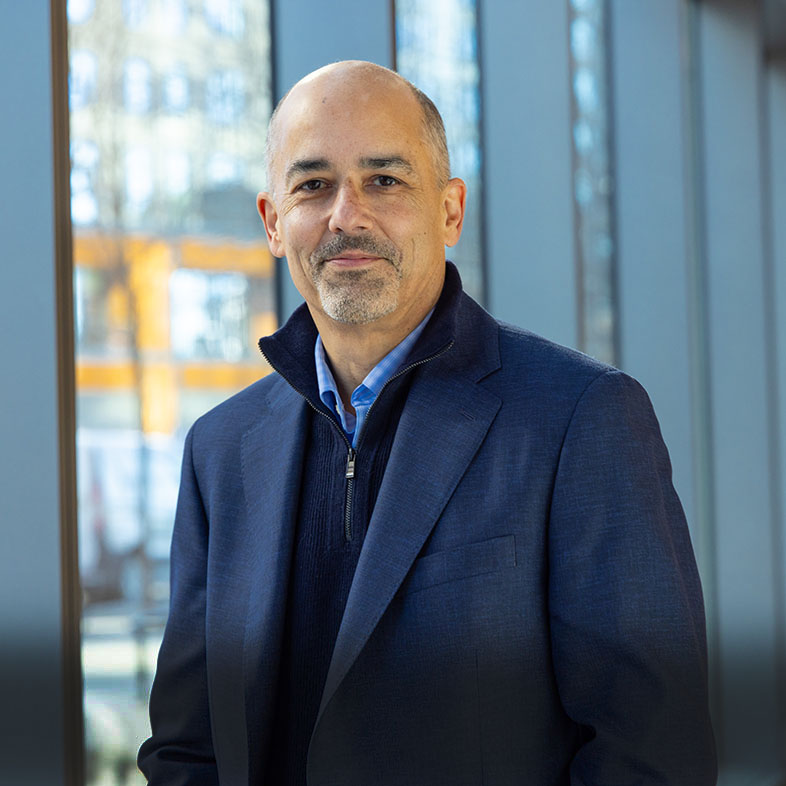
[00:00-00:11] R. Hargreaves
Scientists are inherently curious and they're persistent and breakthroughs don't really always happen easily, but they're resilient.
[00:12-00:16] R. Hargreaves
Understanding the brain is probably one of the most complex pieces of biology.
[00:17-00:33] R. Hargreaves
Not only is the access to it restricted, but also it's actually made up of millions and millions of cells that are interconnected, forming associated circuits that drive all of the emotions, motor behavior, senses.
[00:34-00:40] R. Hargreaves
And understanding these in health then allows us to examine them in disease.
[00:45-00:50] K. Rhodes
Neurodegenerative and neuropsychiatric diseases represent some of the greatest therapeutic challenges of our time.
[00:51-01:01] K. Rhodes
My grandfather actually drove my interest in science and medicine. As he aged, he developed the symptoms of Parkinson's disease, and so I watched his experience with neurodegenerative disease.
[01:02-01:08] K. Rhodes
I saw the impact that that had on him as an individual and as a clinician on the family.
[01:09-01:20] K. Rhodes
These diseases have a huge impact on families, on their caregivers, obviously on the patient themselves and also on society. And as the disease progresses, those impacts become greater.
[01:22-01:27] S. John
Even with the need for better treatments, progress has been hard fought in neuroscience.
[01:28-01:37] S. John
It's been very iterative, we have tested many hypotheses in the clinic and many of those have failed. But with each hypothesis we test, we learn something.
[01:38-01:46] S. John
And we learn something about the human causal biology or the root cause of disease, or we learn something about the targets and the medicines that we've tested.
[01:47-01:54] S. John
Until quite recently, the tools and the knowledge to help us make progress just didn't exist.
[01:58-02:07] K. Rhodes
We're at an incredible new frontier in neuroscience, where we have this deep understanding of the causal drivers of neurodegenerative and psychiatric diseases.
[02:08-02:16] K. Rhodes
Insights from the genetics and the underlying pathology of disease give us clear insights into potential treatment paths that we can take.
[02:17-02:49] S. John
The way that industry and academia have come together to develop neuroimaging techniques and also less invasive biomarker measures that allow us to measure neuroscience, biomarkers from the blood have been hugely powerful. We have now blood-based biomarkers for diseases like Alzheimer's disease and Lou Gehrig's disease and these allow us to really monitor disease and even start to find patients who have pre-symptomatic disease.
[02:50-02:59] S. John
We have much more confidence that we can recruit the right patients with the right pathology at the right time to test the right medicine.
[03:01-03:05] R. Hargreaves
A great example is understanding how Alzheimer's disease progresses over time.
[03:06-03:15] R. Hargreaves
We see the deposition of toxic proteins of amyloid and tau and neuroinflammation within the brain and these occur in a time sequence.
[03:16-03:19] R. Hargreaves
We know where in the disease process we want to intervene.
[03:20-03:34] R. Hargreaves
We now have amyloid therapeutics which are able to slow the progression of the disease and future therapies now have the potential to add on to those and have an even bigger impact.
[03:38-03:56] R. Hargreaves
We have a holistic view of the disease, both from the pathology and from the symptomatology. And our programs really consider that whole human experiences. How can we slow the disease? How are we able to treat the symptoms of the disease? Because that's what's most important to the patient.
[03:57-04:15] K. Rhodes
Whether we're developing an oral drug or an intravenous drug, an antibody or a small molecule, we want to use whatever modality we believe is best to interfere or interact with the underlying biology of disease, guided by that causal human biology.
[04:16-04:21] S. John
Another key to advancing research and development in neuroscience is the use of informatics and predictive sciences at Bristol Myers Squibb.
[04:22-04:42] S. John
Throughout our research history, we generate and collect data and these have become huge data sets. And really, it's the advances in computational methods and mathematics that now allow us to mine those data sets and learn more about targets.
[04:43-04:58] S. John
The goal of these efforts is to enable our research and development teams to run the highest-quality investigational studies faster and more efficiently, and this will enable us to bring transformational medicines to patients more quickly.
[05:03-05:19] K. Rhodes
We have tremendous expertise that we're building across the Bristol Myers Squibb organization that will allow us to efficiently translate discoveries into the laboratory, into our clinical programs, ideally advancing molecules as quickly as possible to treat some devastating diseases.
[05:20-05:35] K. Rhodes
One of the challenges that we still face is delivery of our medicines to the brain. We're actively pursuing technologies that allow us to enhance the transport of molecules across the blood-brain barrier so that they can reach their site of action in the nervous system.
[05:36-05:39] K. Rhodes
I believe there's a tremendous progress on the horizon in neuroscience.
[05:40-05:53] R. Hargreaves
It's a really fulfilling time when you can see that you can bring benefit to people through your career and through work and science that you love to do, so I think it's actually a privilege to work on these problems.
[05:54-06:09] S. John
I really became a geneticist because I just love the idea that genetics can help us answer some of the really tough questions. As I pursued my career, it became obvious that neuroscience is almost the sort of last frontier of biology.
[06:10-06:25] S. John
My dad was diagnosed with schizophrenia when I was a girl, and as I grew up I really saw and understood how invasive and debilitating these diseases can be on all aspects of a person's life.
[06:26-06:37] S. John
What's been really amazing to see is the way that people do come together and share our learnings so that we can accomplish things in neuroscience that simply wouldn't have been possible before.